








Sign up today and see the results for yourself!
Want to speed up your verification process?
Share a screenshot of your ad revenue from the past 3 months.


For a long time, the web ran on an assumption nobody really questioned: most of the traffic came from people. That stopped being as such in 2024, and the gap has continued to widen. Industry research shows that humans accounted for just 47% of web traffic in 2025, while automated traffic made up more than half.
For ad tech platforms, this shift has direct business implications. If your platform sells attention, intent, clicks, leads or impressions, it is helpful to understand how much of the activity behind those metrics comes from real people.
In the latest MonetizeMore webinar, The Ad Fraud Tipping Point, Kean Graham, Founder & CEO of MonetizeMore, and Syed Tanveer Jishan, Chief Innovation Officer, discussed how bots and AI agents are changing online traffic and what that means for ad tech platforms. They covered why bot traffic affects more than publishers, the risks of relying on unverified activity, and why measuring real-user traffic matters.
Drawing on their discussion, this article looks at four assumptions about bot traffic that platforms need to rethink, how real-user traffic is becoming an important metric, and what businesses can do to protect and grow their revenue.
Bot traffic is often treated as a publisher-side issue or something the AdOps team can handle. But automation affects every business that relies on digital activity to generate revenue. These are four assumptions worth reconsidering.
That assumption is becoming harder to defend. Automated traffic now accounts for more than half of web activity, and AI agents are adding another layer of complexity.
Some automation is legitimate. Search engine crawlers, monitoring tools and AI agents can perform useful tasks or act on behalf of real users. The challenge is understanding which activity should count toward the metrics a platform sells.
A click, visit or interaction may look like customer activity in a report. Without traffic-quality checks, it can be difficult to know whether a person was actually behind it.
Publishers are often the first to deal with invalid traffic, but the impact doesn’t stop at the publisher’s website.
Consider the different types of platforms that depend on digital activity:
When a platform sells activity that isn’t actually human, the consequences can reach its customers, reporting, revenue and reputation.
A low invalid traffic (IVT) rate can be reassuring, but it doesn’t tell the whole story.
IVT is not always evenly distributed. A platform might report a low monthly average while experiencing a sharp spike on a particular day or within a specific traffic source.
For example, an illustrative platform might record daily IVT averages of 1.8%, 2.5% and 1.9%, then see a single-day spike to 19%. Looking only at the monthly average could make that spike easy to miss.
The consequences can include advertiser credit requests, account reviews or suspensions, and reporting that no longer reflects genuine customer activity. A month of skewed data can also affect decisions about campaign performance and customer value.
The point is to monitor traffic continuously and look beyond the overall average.
AdOps teams play an important role in monitoring traffic quality, but the impact of invalid activity extends across the business.
Sales teams need reliable figures when pitching customers and renewing contracts. Product teams need trustworthy data to improve platform features and reporting. Finance teams need to understand whether the revenue being recorded reflects legitimate activity.
Traffic quality is a business-wide concern. It affects the numbers a platform reports, the value it delivers to customers and the trust those customers place in its metrics.
Digital advertising measurement has moved through several important milestones, each reflecting a growing need to understand what advertisers were actually getting:
The focus is shifting toward measuring not just ad exposure, but whether a real user is actually present.
The IAB/MRC Attention Measurement Guidelines, finalized in November 2025, require metrics to be based on SIVT-filtered impressions and call for reasonable assurance that a human user is actively present during ad exposure, where applicable.
This makes traffic quality especially relevant for platforms selling attention, engagement or other activity-based metrics.
Measuring real-user traffic can help answer a basic but important question: how much of the activity being measured represents genuine human interaction?
It also gives platforms a more useful way to explain the quality of the inventory or activity they provide.
Measuring real-user traffic starts with identifying and filtering invalid activity. That requires more than relying on a single signal or checking traffic after a problem appears.
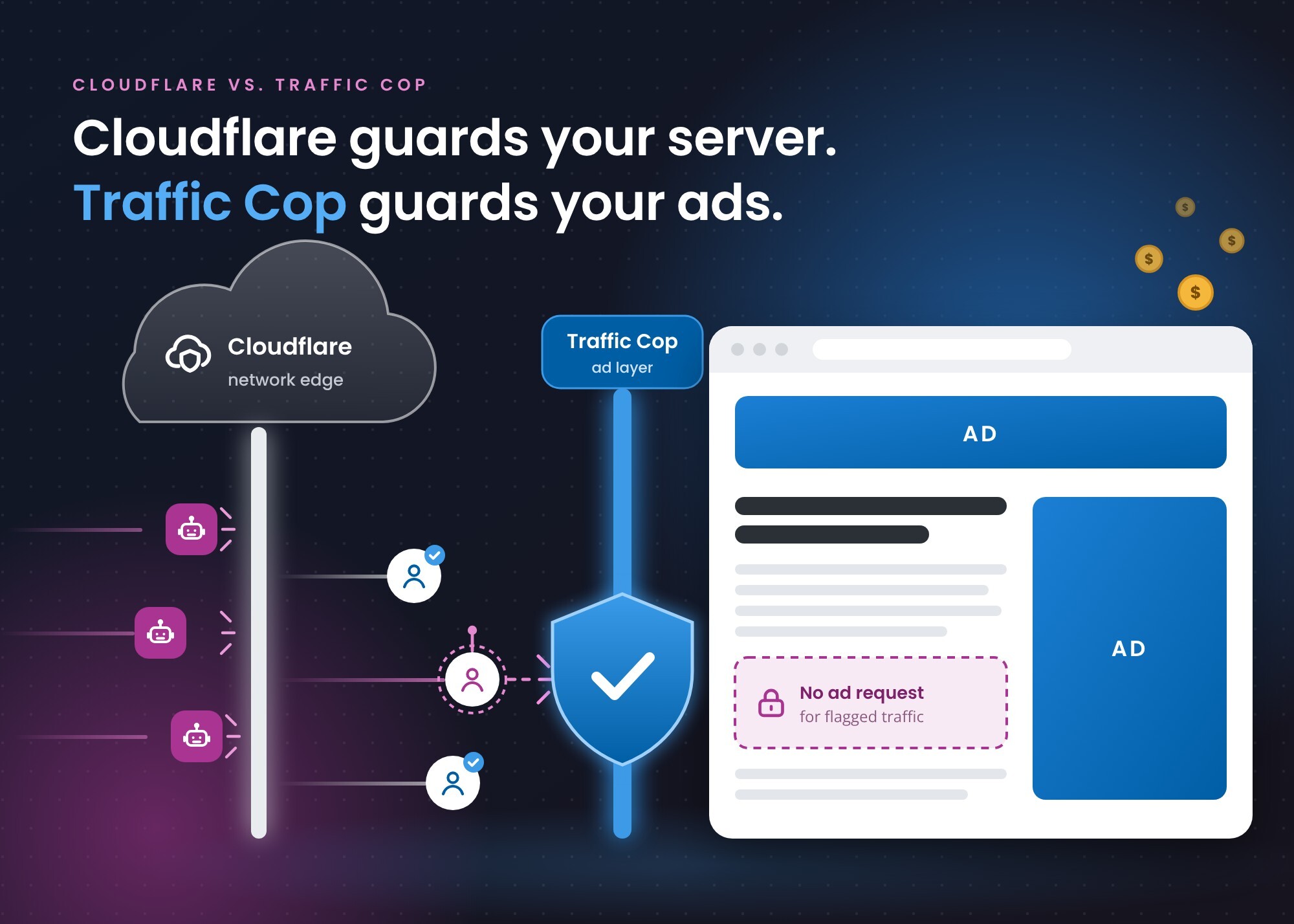
MonetizeMore’s Traffic Cop solution uses more than 140 invalid-traffic signals to identify suspicious activity and adapt to changing threats.
These signals help detect different forms of general invalid traffic (GIVT) and sophisticated invalid traffic (SIVT).
GIVT can include:
SIVT can include:
The distinction matters because sophisticated invalid traffic can be designed to resemble normal user behavior. Looking at multiple signals helps build a more complete picture of traffic quality.
Traffic Cop’s detection models are informed by seven years of monthly analysis and refinement against real-world invalid traffic patterns. This ongoing process helps MonetizeMore adapt its detection approach as traffic sources and tactics change.
Platforms can integrate Traffic Cop through a JavaScript tag on supported pages or through a server-side API for supported use cases.
This gives businesses options for assessing traffic in different environments, including cases where a browser-based tag isn’t suitable.
Detection is only useful if teams can act on what it reveals.
Traffic Cop can provide traffic-quality scores that platforms can use with existing identifiers and rules. For example, a platform could set a rule to block a traffic source when its IVT rate exceeds a defined threshold, such as 10%.
Traffic-quality reporting can also include a verified-human figure alongside existing metrics.
Here’s an illustrative example of how verified-human activity could be represented in a retail media report:
This gives the platform and its customers more context than a click count alone. The figures above are illustrative, not customer data or a representation of a standard Traffic Cop report format.
For publishers also reviewing their AdSense policy compliance, our Ad Policy Grader offers a separate way to assess their sites against AdSense requirements.
Real-user traffic measurement can support more than fraud prevention. It can help ad tech platforms protect existing revenue, strengthen customer relationships and create new commercial opportunities.
When a customer questions the quality of the activity they’re paying for, a platform needs more than a total click or impression count.
Being able to explain the share of activity identified as invalid, and the share verified as human, gives teams a clearer basis for those conversations. It can help address concerns before they turn into credit requests or lost renewals.
Traffic quality can also become part of the sales conversation.
Platforms that can show how they assess real-user traffic have a more meaningful way to discuss the quality of the activity they deliver. This can help differentiate their offering when prospects compare providers or evaluate reporting standards.
As customers pay closer attention to traffic quality, platforms may also explore ways to package verified-human activity as a premium offering.
For example, a platform could introduce a higher-value tier with reporting that includes verified-human metrics. The opportunity will depend on the platform’s business model and what its customers value, but the underlying idea is straightforward: make traffic quality visible and give customers a way to account for it.
The webinar, The Ad Fraud Tipping Point, features Kean and Syed discussing how bots and AI agents are changing online traffic, the challenges this creates for ad tech platforms, and why it’s becoming more important to distinguish real-user activity from invalid traffic.
If your platform sells clicks, impressions, leads or attention, it’s worth knowing how much of that activity comes from real users. Book a free ad fraud consultation with the MonetizeMore team to discuss your traffic quality, identify potential IVT risks and explore how Traffic Cop can help.
Real-user traffic refers to website or platform activity generated by actual people. Measuring it helps businesses understand how much of their reported activity comes from human interactions rather than automated requests, bots or other non-human activity.
Ad tech platforms often sell or report metrics such as impressions, clicks, attention, leads and buying intent. Automated activity can inflate or distort these metrics, affecting customer trust, campaign reporting, revenue and business decisions.
Platforms can use multiple traffic-quality signals to identify general and sophisticated invalid traffic. Solutions such as Traffic Cop analyze traffic patterns and signals to help detect suspicious activity, filter invalid traffic and provide more visibility into verified-human activity.

Product Marketing @ MonetizeMore

10X your ad revenue with our award-winning solutions.