





![What are the best ways to optimize Video Earnings [2022]](https://www.monetizemore.com/wp-content/uploads/2021/12/What-are-the-best-ways-to-optimize-Video-Earnings-2022.jpeg)

Sign up today and see the results for yourself!
Want to speed up your verification process?
Share a screenshot of your ad revenue from the past 3 months.
The ‘black box’ of Demand-Side Platforms (DSPs) is losing its opacity. By April 2026, major industry players like Amazon will make transparency mandatory. This is a critical window for publishers to audit their stacks and reclaim margins lost to hidden fees.
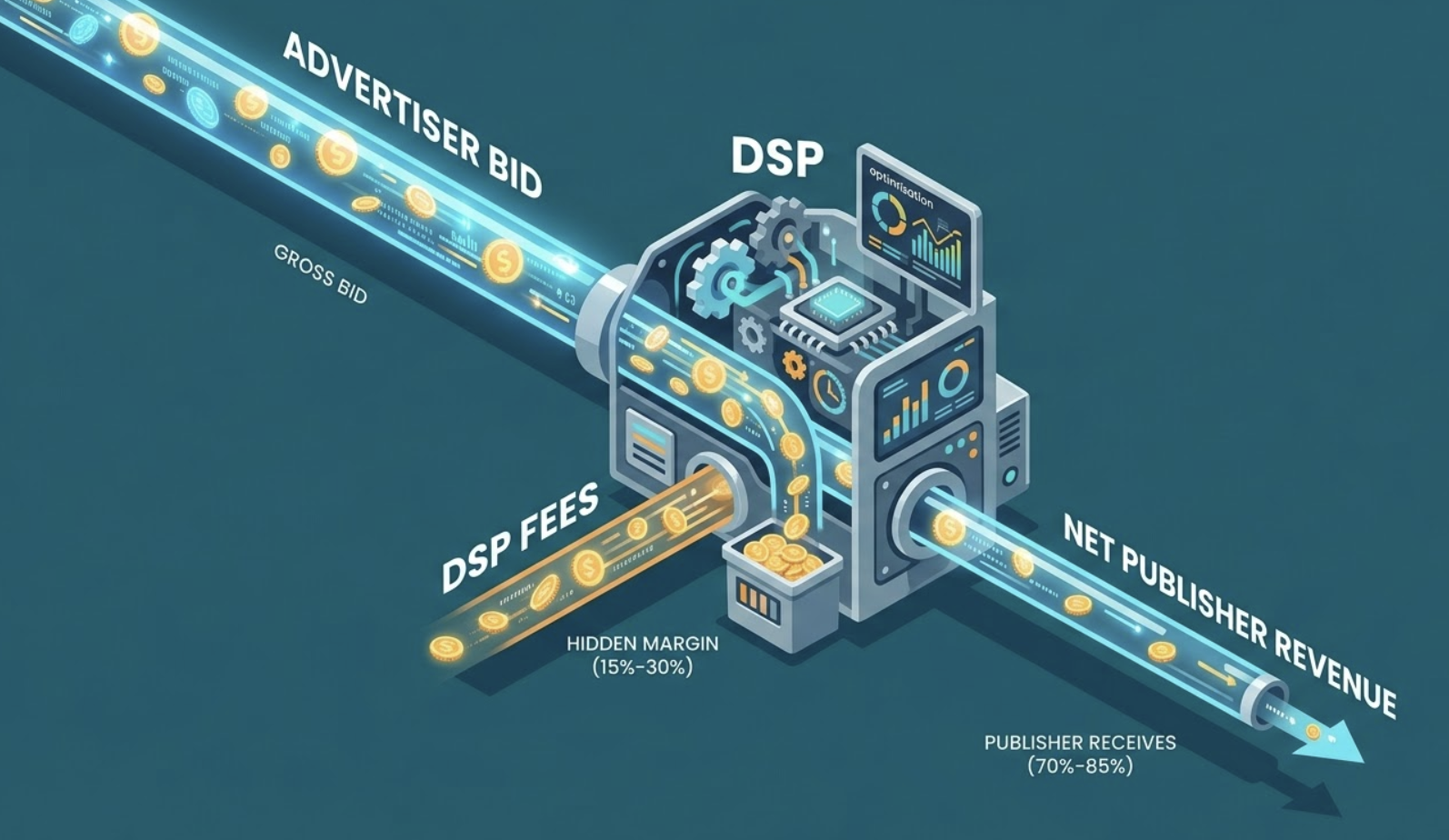
Most publishers currently operate with a significant blind spot. While clearing prices are visible in your dashboard, the take rate or the spread between an advertiser’s bid and what you receive remains obscured.
Recent data from Adalytics reveals the scale of this leakage:
Amazon’s push for mandatory DSP transparency forces disclosure of fee structures and bidding logic. For publishers running multi-DSP stacks, this creates a “Transparency Opportunity” to audit partners based on raw performance rather than high-level reporting.
Publishers with immediate access to log-level data can pivot floor prices and demand partnerships instantly to maximize yield as these fees become visible.
Consider a publisher with 10 million monthly impressions:
| Metric | Opaque Environment | Transparent Environment |
| Advertiser Bid | $5.00 CPM | $5.00 CPM |
| Hidden Leakage | 30% ($1.50) | 15% ($0.75) |
| Publisher Net | $3.50 CPM | $4.25 CPM |
| Monthly Total | $35,000 | $42,500 |
This represents a $7,500 monthly revenue gap on a single demand partner.
To audit your stack before the April 2026 transparency deadline, you need to move beyond high-level dashboard metrics. Use these technical expansion points to evaluate your demand partners:
Standard reporting aggregates data, which hides discrepancies. You need access to raw bid logs to perform a “bid-to-win” reconciliation.
Vague “service fee” language in older MSAs is no longer sufficient. As transparency becomes mandatory, your contracts must reflect the new reality.
Bid shading is a buyer-side tool designed to find the lowest possible price to win an impression. While common, it often works against publisher yield.
The goal of SPO is to find the shortest, cheapest path from the advertiser to your inventory.
The March 2026 enforcement of TCF 2.3 introduces stricter requirements for how consent is communicated within the bid request.
You do not need to wait for the April 2026 deadline to see your data. Our PubGuru technology now provides full bid-stream transparency. We allow you to see exactly what every DSP bids and the specific margin they retain.
While the rest of the industry waits for mandatory reports, our partners are using historical log-level data to optimize auctions and select high-efficiency demand partners.

With over ten years at the forefront of programmatic advertising, Aleesha Jacob is a renowned Ad-Tech expert, blending innovative strategies with cutting-edge technology. Her insights have reshaped programmatic advertising, leading to groundbreaking campaigns and 10X ROI increases for publishers and global brands. She believes in setting new standards in dynamic ad targeting and optimization.

10X your ad revenue with our award-winning solutions.