





Sign up today and see the results for yourself!
Want to speed up your verification process?
Share a screenshot of your ad revenue from the past 3 months.
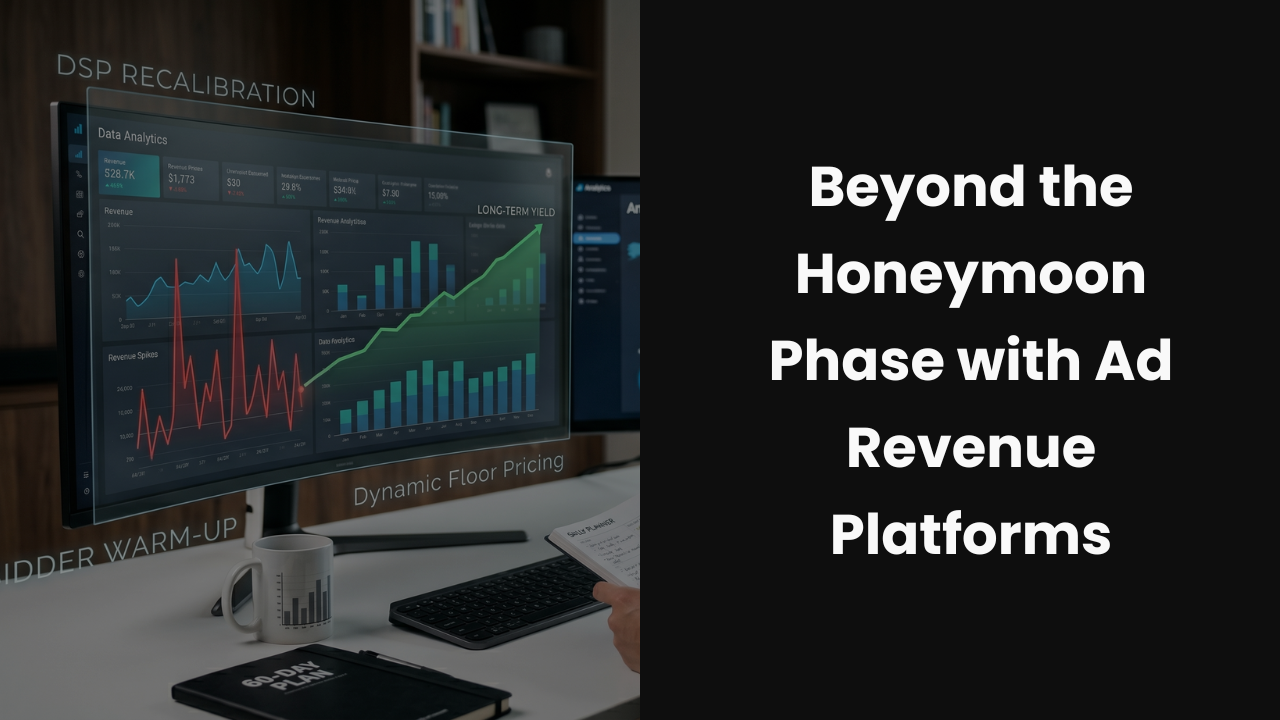
Short-term spikes after switching ad revenue platforms are usually temporary, as DSPs, cookie syncing, and price floors need 30 to 60 days to settle into a true baseline. Our approach focuses on long-term yield per session, robust invalid traffic (IVT) protection, and a diversified stack, helping publishers avoid “platform hopping” and build sustainable growth instead of chasing temporary honeymoon RPMs.
| Topic | Key Insight | Why It Matters | Action Item |
|---|---|---|---|
| Honeymoon Phase | Week-one spikes are usually due to DSP learning, not true long-term earnings. | Misreading early spikes leads to panic-driven platform hopping. | Commit to a 60-day evaluation window before judging a new ad stack. |
| DSP & Cookie Sync | Systems need 30 to 60 days to build audience match rates and bidder confidence. | High-value bidders won’t commit full budgets until they trust your inventory. | Avoid major layout or floor changes in the first month to let learning finish. |
| RPM vs. Yield | High RPM often hides low fill rates and lost impressions. | Total yield pays the bills, not daily RPM screenshots. | Track Revenue Per Session and fill rate by geography and device. |
| Floor Pricing | Static high floors boost short-term stats but hurt long-term fill. | Overly aggressive floors drive buyers away and stall growth. | Use dynamic floor pricing that adapts to real-time market demand. |
| Invalid Traffic (IVT) | Bots inflate early numbers, leading to later revenue clawbacks. | Google can remove past earnings or disable accounts due to IVT. | Deploy Traffic Cop to block fake traffic before it hits your demand partners. |
| Technical Health | Poor site performance lowers viewability and bid prices. | Slow pages reduce advertiser confidence and user retention. | Monitor Core Web Vitals and ad latency to protect the user experience. |
| Diversification | Single “black box” platforms increase opacity and risk. | One vendor’s algorithm change can sharply impact your entire business. | Build a stack with multiple SSPs, header bidding, and transparent reporting. |
| MonetizeMore’s Role | Focus on long-term yield and account protection over quick spikes. | Stable growth supports a sustainable, scalable publishing business. | Leverage PubGuru and Traffic Cop for a 60-day optimized ad stack audit. |
The best platforms for ad revenue optimization trade short-term spikes for stable, growing yield over 60 days and beyond. Whether a publisher is moving from AdSense, AdX, a previous managed partner, or another header bidding setup, the pattern is nearly always the same: a significant RPM jump in week one, followed by a painful dip around day 30. This dip is not a scam; it is the technical reality of how programmatic systems learn, sync, and recalibrate. At MonetizeMore, we have spent 16+ years guiding publishers through this exact pattern, turning the “honeymoon spike” into a foundation for long-term growth.
We have watched this story play out hundreds of times: a publisher joins a new platform or partner, refreshes their dashboard hourly, and sees impressive week-one numbers. By day 30, that initial lift has shrunk considerably, or vanished entirely. Panic sets in, leading to questions about “bait and switch” tactics. From our vantage point, analyzing log-level data across billions of impressions, the answer is consistent: what you are witnessing is the normal life cycle of DSP learning, cookie syncing, and market stabilization.
Most publishers misread the first 30 days because dashboards reward emotion over patience.
First comes excitement as RPMs spike sharply in the first few days. Publishers start projecting these numbers over 12 months, mentally spending revenue that has not yet stabilized. Next comes overconfidence, where the previous baseline gets ignored. Finally, the day-30 dip hits, trust cracks, and many publishers resort to “platform hopping.” This cycle kills long-term optimization because each switch resets the technical learning clock, keeping you in a permanent, volatile honeymoon phase.
Your revenue is not crashing; it is recalibrating as the ecosystem determines your inventory’s true market value.
DSPs often overpay initially to gather data, then settle into efficient bidding once they have enough signal.
When a publisher joins our network, the DSPs bidding on their inventory through our 60+ demand partners treat that supply as new and unknown. These algorithmic buyers, which include platforms like Google’s Display & Video 360 (DV360), The Trade Desk, and Amazon DSP, bid broadly at first to test viewability, audience quality, and conversion signals across your ad slots. This initial overbidding is what creates the week-one spike. Once each DSP collects enough data through the SSP and exchange layer, it recalibrates to what the market actually sustains. If you judge a new setup on the first seven days, you are judging a test, not a final result.
Meaningful bidder competition builds gradually as audience match rates mature across your demand stack, a process that typically takes 30 to 60 days.
When your inventory enters our supply-side stack, DSPs and SSPs must sync user IDs through a process called cookie matching. Each time a user visits your site, the SSP and DSP exchange identifiers so that buyers can recognize and value that audience segment. In the early weeks, match rates are low because buyers have only seen a fraction of your audience. As more of your users get identified and matched across our demand partner network, bidders gain confidence in your traffic quality and begin committing higher budgets. This gradual build in match rates and bidder density is the true engine of long-term revenue growth, and it cannot be rushed.
A high RPM screenshot can mask low fill rates and poor total earnings.
Aggressive price floors can produce impressive RPMs for a small slice of traffic, but at the cost of unsold inventory. High RPM is a vanity metric; total yield is our north star. At MonetizeMore, we use dynamic floor pricing to find the sweet spot where floors are high enough to maintain value but low enough to maximize fill across our entire demand partner network.
One of the most damaging mistakes publishers make is evaluating a new ad stack too early. This is an industry-wide challenge, not unique to any single platform or partner. Most managed ad partners across the industry advise publishers to allow at minimum two weeks just for demand partners to ramp up to optimal spending on new inventory. But two weeks only tells you whether the technical setup is working. It tells you almost nothing about whether your stack is performing at its true potential.
True yield optimization takes longer because the variables driving it, including user ID match rates, DSP bidding patterns, floor price calibration, and bidder density, all compound over time. Based on what we see across our publisher network, the picture typically develops in three phases:
This is why we advise publishers to use a 60-day trailing average as their benchmark when assessing any new setup, including ours. Anything shorter is measuring the adjustment period, not the outcome.
If invalid traffic (IVT) inflates your honeymoon numbers, Google will reclaim that revenue via clawbacks later.
Without strong IVT protection, early spikes are often an illusion caused by bots. We built Traffic Cop to detect and block sophisticated bot patterns before they reach your demand partners, drastically reducing the risk of revenue deductions or account suspensions.
Look beyond RPM; ask what you are leaving on the table. Are your floors too high for specific geographies? Does a placement have great RPM but only 20% fill? Any serious platform must provide this level of granular transparency.
Relying on a single “black box” increases risk. We build diversified stacks including header bidding with multiple SSPs and direct AdX access, pulling demand from 60+ partners to maximize competition for every impression. Our publishers often see significant page RPM increases once we deploy a fully optimized, competitive stack.
The day-30 dip is sometimes caused by site performance issues. We monitor Core Web Vitals and ad latency, because poor user experience leads to lower viewability and weaker advertiser confidence across your entire demand stack.
This is the most common question we hear from publishers. The initial spike is driven by DSPs overbidding on new inventory while they gather data. Once their algorithms have enough signal, they shift to efficient bidding, which reflects the true market value of your traffic. It is not a platform problem; it is how programmatic buying works. The fix is patience and a 60-day evaluation window, not switching platforms again.
AdSense RPM varies widely by niche, geography, and traffic quality, typically ranging from $0.50 to $3 for general content, with premium niches like finance and health earning considerably more. Publishers who move to AdX or a managed platform like MonetizeMore access a more competitive auction with multiple demand sources bidding simultaneously, which is what drives meaningful RPM improvement over time.
Geography does most of the heavy lifting. Traffic from Tier 1 markets like the US, UK, Canada, and Australia can generate five to ten times the RPM of equivalent traffic from other regions. Here are approximate page RPM ranges for Tier 1 traffic by niche:
| Niche | Approx. Page RPM (USD, Tier 1) |
|---|---|
| Health and Wellness | $5 to $18 |
| E-commerce | $3 to $10 |
| Travel | $3 to $9 |
Actual RPM depends on ad setup, viewability, seasonality, and your specific audience mix.
Track Revenue Per Session (RPS) and fill rate broken down by geography and device. RPM tells you the value of impressions that sold; RPS tells you the value of every user who visited your site, including impressions that did not sell. That is the number that actually reflects the health of your monetization setup.
True ad tech success is predictable, consistent, and protected. At MonetizeMore, we prioritize transparent, data-driven decisions and long-term yield over temporary honeymoon spikes. Ready for a different approach?
If you are tired of chasing honeymoon phases, it is time for a professional audit. We provide a clear, honest plan showing your realistic 60-day revenue potential. Let us show you how to treat your site like a long-term business.

Marketing MBA and Global Marketing Manager at MonetizeMore.




10X your ad revenue with our award-winning solutions.