






Sign up today and see the results for yourself!
Want to speed up your verification process?
Share a screenshot of your ad revenue from the past 3 months.
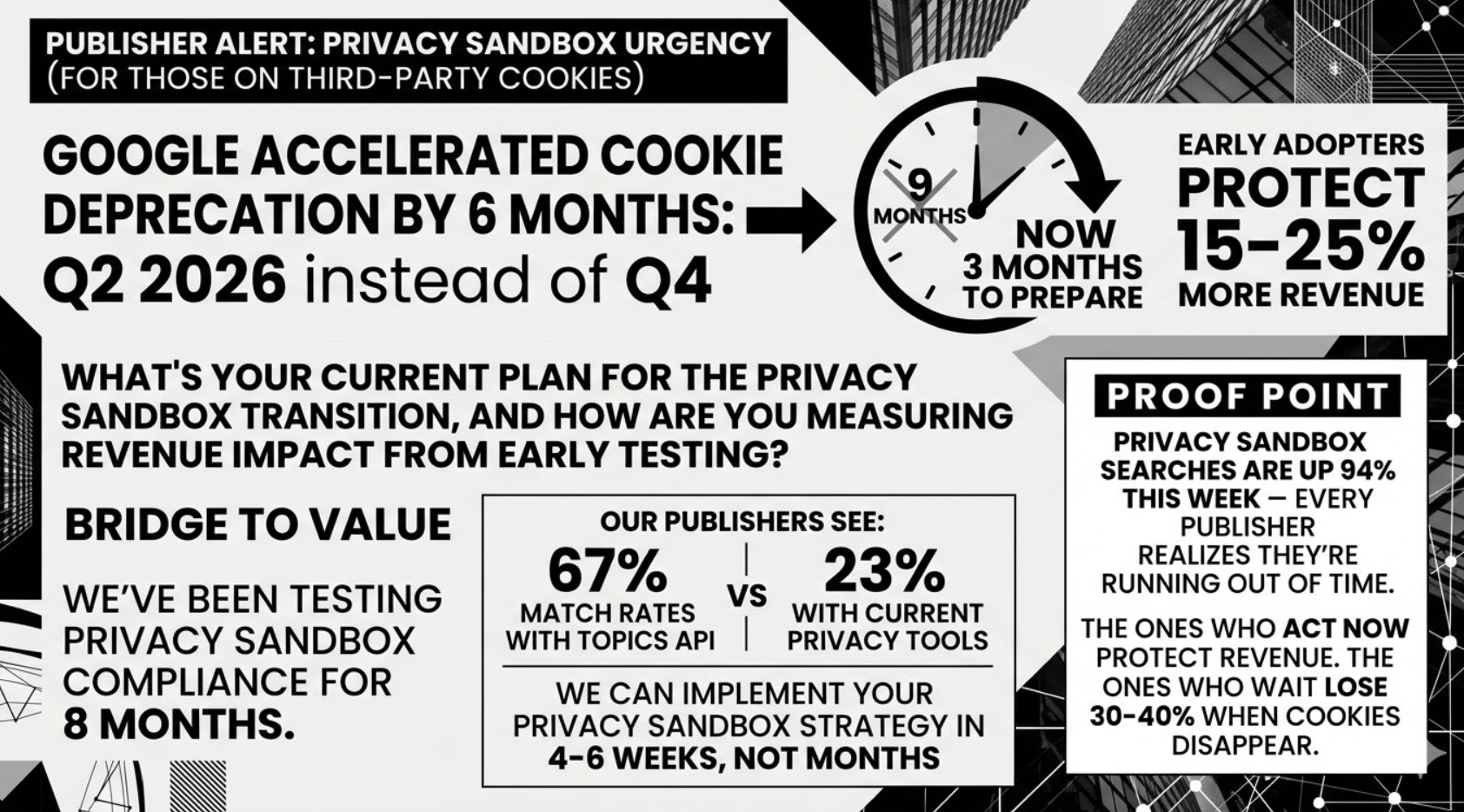
Here is a number that should get your attention: ad revenue drops of 30 to 40 percent. That is what research consistently shows when third-party cookies disappear without a publisher having a Privacy Sandbox strategy in place. Not a rounding error. Not a manageable dip. A structural cut to your programmatic income, the kind that takes years to recover from.
Until recently, publishers told themselves they had time. Google’s original deprecation timeline pointed to Q4 2026. There were roadmaps, working groups, “we’ll get to it in Q3” conversations. Then Google moved the deadline up by six months to Q2 2026, and those nine months of preparation quietly became three.
This is not a drill. Privacy Sandbox searches jumped 94% in a single week as publishers woke up to what that acceleration actually means for their bottom line. The ones acting now are protecting their revenue. The ones waiting are setting themselves up for one of the most painful quarters they will ever report.
Google has moved third-party cookie deprecation from Q4 2026 to Q2 2026. Publishers who built their preparation timeline around the original date now have roughly 90 days fewer than expected. If your Privacy Sandbox testing has not started, you are already behind.
MonetizeMore has been running Privacy Sandbox compliance testing across publisher portfolios for eight months. The data is clear. Publishers who adopted early and integrated the Topics API into their identity strategy are outperforming those still relying on legacy tools by a wide margin.
A 67% match rate versus 23% is not a marginal improvement in targeting efficiency. It is the difference between keeping your CPMs intact and watching them crater when advertisers cannot find their audiences on your inventory. Buyers do not chase publishers who cannot deliver addressable reach. They reallocate spend within 48 hours to whoever can.
1- Google begins limited third-party cookie deprecation testing. Most publishers treat it as distant background noise.
2- Privacy Sandbox APIs enter broader availability. MonetizeMore begins full publisher testing program. Early adopters start accumulating data advantages.
3- Google accelerates the timeline by 6 months. Q4 2026 is now Q2 2026. Publishers relying on the original schedule are suddenly behind. Privacy Sandbox searches jump 94% in a single week.
4- Third-party cookies gone. Publishers without a tested Privacy Sandbox strategy face 30-40% revenue loss. No grace period. No rollback.
Skeptics tend to wave off cookie deprecation impact numbers as inflated. They are not. The mechanism is straightforward: advertisers pay a premium for addressable audiences. Third-party cookies are currently the primary mechanism for audience addressability in open programmatic. When they go, publishers without a functional replacement see:
| Revenue Driver | With Privacy Sandbox Ready | Without Preparation |
| Average CPM | Holds within 10-15% of current | Drops 30-40% immediately |
| Audience Match Rate | 65-70% with Topics API | Sub-25% with legacy tools |
| Advertiser Retention | High – audiences remain findable | Low – buyers reallocate budget fast |
| Time to Recover | N/A – never fell significantly | 12-18 months, minimum |
| Competitive Position | Gains share from unprepared peers | Loses share to prepared peers |
The publishers who are prepared do not just protect their own revenue. They absorb spend from publishers who are not. This is a zero-sum reallocation event.
Every dollar of budget that leaves an unprepared publisher has to go somewhere, and it ends up in inventory that can still deliver audience confidence.
Track your preparation across these five areas before Q2 2026. Click to check off items as you complete them.
-Audit which ad revenue streams currently depend on third-party cookies
-Run a cookie dependency report across your SSP and DFP setup
-Identify your top 10 advertiser categories by CPM to map against Topics API coverage
-Benchmark your current audience match rate with existing tools (get a baseline before switching).
-Confirm your ad tech stack has Topics API support enabled (GAM, Prebid, or header bidding wrapper)
-Enable Topics API signal passing in your header bidding configuration
-Map your site content categories to the official Topics API taxonomy (there are 350+ categories)
-Run a 2-week A/B test comparing Topics API CPMs against your current audience signals.
-Implement or audit your first-party data collection (email capture, login walls, newsletters)
-Connect first-party audience segments to your ad server for supplemental targeting signals
-Evaluate contextual targeting solutions to reinforce CPMs in cookieless environments.
-Model Q2 2026 revenue under three scenarios: fully prepared, partially prepared, and unprepared
-Brief your key direct advertisers on your Privacy Sandbox approach before Q2
-Set a floor CPM policy for cookieless traffic to avoid bid stream degradation
-Diversify demand sources: ensure you have at least 4-5 SSP relationships active before deprecation.
-Establish a Privacy Sandbox match rate tracking dashboard (weekly monitoring, not monthly)
-Set a minimum acceptable CPM threshold for Topics API traffic before full cutover
-Run post-deprecation revenue simulations using your actual Q1 2026 data as the baseline.
One of the most common questions MonetizeMore hears from publishers right now is: “How long does Privacy Sandbox implementation actually take?” The honest answer depends on where you are starting from, but for a publisher with a standard GAM setup and header bidding in place, the baseline configuration takes four to six weeks when done properly. That includes Topics API integration, initial testing, match rate calibration, and first-party data layer setup.
Four to six weeks sounds manageable, but you’ll need four to six additional weeks of live data to optimize those match rates to a competitive level before the deprecation date. Do the arithmetic, and you have a real deadline problem for publishers who have not started.
The publishers who came to MonetizeMore in August 2025 are now in the final optimization phase with tested, performing setups. The ones arriving in February 2026 are racing the clock. The ones who arrive in April will not have enough time to test properly before Q2 hits.
You can implement Privacy Sandbox in four to six weeks. But you need four to six weeks after that to optimize it. The clock is ticking on both.
MonetizeMore did not wait for the urgency to arrive before building expertise. The team has been running Privacy Sandbox compliance testing across publisher portfolios since mid-2025, which means the playbook is written, the pitfalls are mapped, and the optimization patterns are understood.
The 67% Topics API match rate that MonetizeMore publishers are achieving is not a lucky outcome. It comes from understanding which content taxonomies map most effectively to Topics categories, how to structure bid stream signals to maximize advertiser matching, and how to layer first-party data to supplement gaps in the Topics API’s coverage. That knowledge took eight months to accumulate. Publishers trying to figure it out on their own in the next 90 days will learn the expensive way.
We have the testing data, the implementation playbook, and the team to get your Privacy Sandbox strategy live before cookie deprecation hits. Publishers who start now protect their CPMs. Publishers who wait lose 30-40% and spend a year chasing it back. Get your Privacy Sandbox Audit now!
The Topics API is Google's primary replacement mechanism for third-party cookie-based behavioral targeting. Instead of tracking users across sites, it assigns broad interest categories to browsers based on recent browsing history. Those topics are shared with advertisers on a need-to-know basis, with user privacy protected at the browser level. The critical thing publishers need to understand: Topics API match rates are trainable. The 67% figure MonetizeMore publishers are hitting did not happen on day one. It is the result of eight months of progressive testing, audience segment mapping, and bid stream optimization. Publishers who start today will reach competitive match rates before Q2. Publishers who start in April will not have enough runway to get there in time.
Three variables drive Topics API performance for publishers: the breadth of your content taxonomy alignment with Topics categories, the quality of your first-party data signals supplementing the API, and the optimization work done on how topic signals are passed into the bid stream. All three take time. None of them can be shortcut by throwing engineering hours at the last minute.

With over ten years at the forefront of programmatic advertising, Aleesha Jacob is a renowned Ad-Tech expert, blending innovative strategies with cutting-edge technology. Her insights have reshaped programmatic advertising, leading to groundbreaking campaigns and 10X ROI increases for publishers and global brands. She believes in setting new standards in dynamic ad targeting and optimization.

![What are the best ways to optimize Video Earnings [2022]](https://www.monetizemore.com/wp-content/uploads/2021/12/What-are-the-best-ways-to-optimize-Video-Earnings-2022.jpeg)

10X your ad revenue with our award-winning solutions.